














Finding Love vs. Finding the Right Person: Which Framework Actually Works?
Introduction: The Question You Should Be Asking
There’s a question that haunts women navigating modern dating: “Why do I keep ending up in the same situations?”
Maybe you’ve read The Five Love Languages—Gary Chapman’s 1992 phenomenon that’s sold over 20 million copies. Maybe you took the quiz, identified your love language as “Quality Time” or “Words of Affirmation,” and thought you finally had the answer. Maybe you even tried to implement it in your last relationship.
And maybe it still ended the same way.
Here’s the uncomfortable truth: The Five Love Languages answers the wrong question. It tells you how to express love. But if you’re struggling with endless first dates, situationships that go nowhere, or relationships where commitment never materializes—your problem isn’t expression. Your problem is selection.
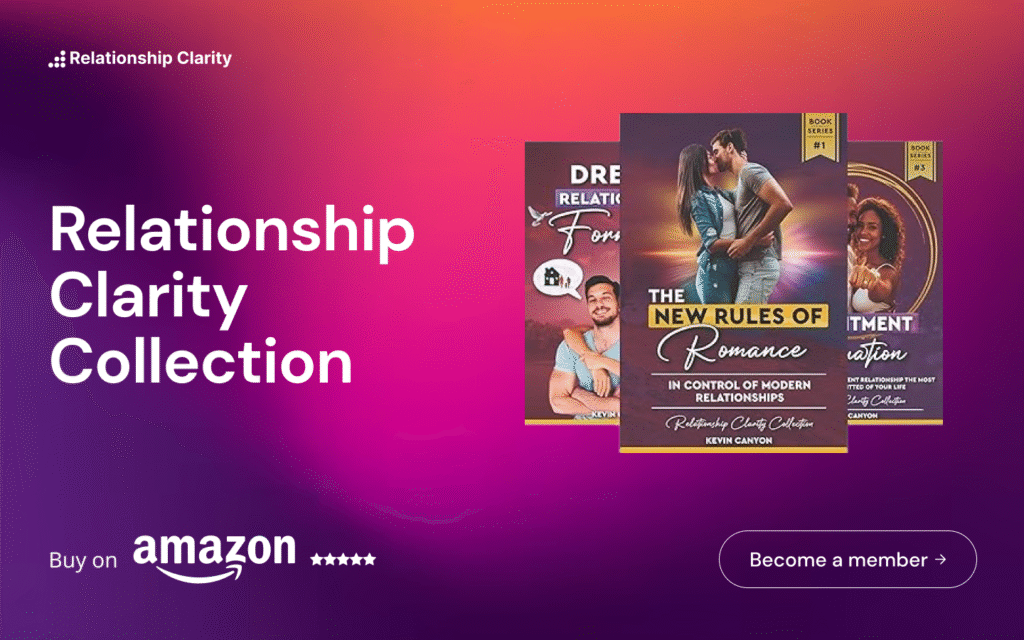
The Dream Relationship Formula by Kevin Canyon tackles that problem directly. Instead of asking “How do I show love?” it asks “How do I identify whether this person is even capable of building the relationship I want?”
Let’s break down both frameworks and discover which one actually helps you stop wasting time on the wrong people.
The Five Love Languages: A Quick Overview
Author: Gary Chapman (Baptist pastor and marriage counselor)
Published: 1992
Target Audience: Married couples seeking to improve existing relationships
Core Premise: Every person has a primary “love language”—a specific way they prefer to give and receive love. The five languages are Words of Affirmation, Quality Time, Receiving Gifts, Acts of Service, and Physical Touch. Relationship problems often stem from partners “speaking different languages.”
Chapman’s thesis is intuitive: if your love language is physical touch but your partner expresses love through acts of service, you might not feel loved—even when they’re genuinely trying. Learn each other’s language, and connection improves.
The appeal is obvious. It’s simple, memorable, and gives couples a shared vocabulary. It’s also become cultural shorthand—first-date conversations now include “So, what’s your love language?”
The Dream Relationship Formula: A Quick Overview
Author: Kevin Canyon
Published: 2025
Target Audience: Single women and women entering new relationships who want to start on the right foundations
Core Premise: Successful relationships aren’t about finding “the one” and learning to communicate better. They require a systematic assessment of five critical pillars that must all be present: The Right Man, At The Right Time, In The Right Place, With The Right Goals, Who Wants You.
Canyon’s approach is fundamentally different from traditional relationship advice. Rather than teaching you to adapt to whoever you’re with, it provides a multi-dimensional framework for evaluating whether someone is actually capable of building what you want.
The book dives deep into attachment theory, the science of partner selection, and why people often end up with partners who don’t match their stated ideals—providing tools to break that pattern.
Point-by-Point Comparison
1. Scientific Foundation
The Five Love Languages
A 2024 comprehensive review by Emily Impett and colleagues at the University of Toronto evaluated Chapman’s three core claims. Their findings were damning:
- “Each person has a primary love language”—Not supported. When researchers didn’t force choices, participants rated all five languages as important.
- “There are exactly five distinct languages”—Not supported. Other research found seven categories with significant overlap.
- “Speaking the same language improves relationships”—Not supported. No study found strong evidence that love language matching predicts satisfaction.
Chapman himself admits he “has not written this book as an academic treatise.” The framework emerged from clinical observation with “white, religious, mixed-gender, traditional couples”—without control groups, statistical analysis, or peer review.
The Dream Relationship Formula
Canyon takes a fundamentally different approach—building on established, peer-reviewed research rather than intuition. The book includes dedicated chapters reviewing scientific literature, with studies like:
- Eastwick et al. (2014): Meta-analysis of 97 studies on partner preferences and actual choices
- Valentine et al. (2020): Research showing warmth-trustworthiness predicts attraction and long-term satisfaction
- Eastwick & Neff (2012): 3.5-year study showing “pattern match” (how well partner traits match ideals) predicts marital stability
- Campbell et al. (2016): Evidence that people form relationships with partners who match their ideal preferences over time
Critically, Canyon doesn’t just cite research—he critically evaluates it, noting limitations like sample demographics (young, college-educated couples) and potential biases (financial compensation affecting responses).
Verdict: The Dream Relationship Formula is grounded in peer-reviewed relationship science with transparent methodology. The Five Love Languages is intuition presented as science.
2. Framework Depth and Diagnostic Power
The Five Love Languages
The framework is elegantly simple: five categories, a quiz, and actionable advice (“speak your partner’s language”). This simplicity is both its strength and fatal weakness.
It cannot help you answer:
- Is this person actually capable of intimacy, or are they avoidantly attached?
- Does he share my core values about family, career, and life goals?
- Is he emotionally available right now, or dealing with unresolved issues?
- Are we compatible beyond surface-level attraction?
- Why does he say he wants a relationship but never actually commit?
The Dream Relationship Formula
Canyon provides a multi-layered diagnostic system that addresses exactly these questions.
The Five Pillars Framework:
- The Right Man — Not about looks or status. This means the right identities (how he sees himself), beliefs (about relationships, commitment, women), values (what he prioritizes), and behaviors (what he actually does). A man who identifies as a “bachelor” and “player” has different relationship potential than one who identifies as “husband material.”
- At The Right Time — Is he emotionally available? Focused on career? Healing from a divorce? Processing trauma? The same man at different life stages has dramatically different capacity for relationship building.
- In The Right Place — Geography, lifestyle compatibility, social circle alignment. Long-distance rarely works. Different life structures create friction.
- With The Right Goals — Does he want marriage? Children? Career advancement? If your goals are fundamentally misaligned, no amount of “love language” fluency will bridge that gap.
- Who Wants You — Perhaps most critical. A man can meet every other criterion, but if he’s not genuinely invested in YOU specifically, nothing else matters.
Beyond the pillars, the book provides extensive frameworks for:
- Attachment style assessment: Detailed profiles of secure, anxious, avoidant, and fearful-avoidant styles—including how to recognize each in yourself and partners, advantages and disadvantages of each pairing, and strategies for navigating relationships with each type.
- Values alignment mapping: Research shows 90% of traits analyzed—from political views to substance use—show partner similarity in successful relationships. The book provides tools for assessing this alignment.
- Red flag identification: Concrete behavioral indicators that predict relationship failure, organized by attachment style and relationship stage.
Verdict: Love languages gives you five categories to understand expression preferences. The Dream Relationship Formula gives you a comprehensive diagnostic system to evaluate whether someone can actually build what you want.
3. Practical Application for Singles
The Five Love Languages
Here’s the fundamental problem: Chapman wrote this book for married couples. The entire framework assumes you’re already with someone committed to making it work.
For single women navigating dating apps, situationships, and commitment-phobic partners, this assumption is catastrophically unhelpful. You can learn someone’s love language perfectly, but if they’re:
- Avoidantly attached and terrified of intimacy
- Using you for companionship while keeping options open
- Fundamentally opposed to marriage or children
- Still processing their last relationship
…no amount of “speaking their language” will change those realities. In fact, it might make things worse—because now you’re investing more effort into someone who was never going to meet you halfway.
The Dream Relationship Formula
Canyon writes explicitly for “women who are currently single or entering into a new relationship.” The book addresses:
- Dating app strategy: How to assess attachment styles from texting patterns, recognize intentions early, and avoid common traps
- First date assessment: What behaviors to look for, questions to ask, and red flags that predict future problems
- The stated vs. actual preferences gap: Why people say they want certain things but choose differently—and how to ensure you don’t fall into this trap
- Self-assessment tools: Identifying your own attachment style, understanding your patterns, and recognizing when you’re unconsciously sabotaging good opportunities
One particularly powerful insight: research shows that what people say they want in a partner often doesn’t predict who they actually choose. Canyon addresses this directly with tools for identifying this gap in yourself and potential partners.
Verdict: Love languages helps you express love to someone you’ve already committed to. The Dream Relationship Formula helps you figure out who deserves your commitment in the first place.
4. Underlying Assumptions About Relationships
The Five Love Languages
Chapman’s framework rests on several implicit assumptions:
- Both partners are genuinely committed and acting in good faith
- The primary problem is communication style, not character or values
- Learning to “speak” each other’s language will resolve core issues
- Religious framing: “God chose you for each other”
These assumptions work reasonably well for stable marriages with communication issues. They’re dangerous for women dealing with:
- Partners who weaponize the framework (“You’re not speaking MY language”)
- Avoidant partners who use “Quality Time is my language” to justify emotional unavailability
- Situations where the problem is investment level, not expression style
The Dream Relationship Formula
Canyon operates from different assumptions:
- Not every person is capable of the relationship you want—selection matters
- Attachment styles and early experiences profoundly shape relationship capacity
- Values alignment predicts long-term success better than communication style
- The modern relationship environment has fundamentally changed the game
- Your time is your most valuable asset—don’t waste it on bad investments
A key quote from the book: “Most women have so much to offer the right man but too many invest their time, energy & emotional wellbeing into men who were never right for them and who have absolutely no reason to be in a relationship with them in the first place.”
Verdict: Love languages assumes you’re with someone worth investing in. The Dream Relationship Formula helps you determine whether that assumption is even true.
5. Limitations of Each Framework
The Five Love Languages: Critical Gaps
- No selection criteria: Assumes you’re already with someone suitable
- Ignores attachment theory: The single most predictive framework for relationship dynamics
- Can enable poor treatment: “If I just speak his language better” becomes an excuse to tolerate unacceptable behavior
- Missing dimension of autonomy: Research shows supporting partners’ individual goals matters—something Chapman ignores entirely
- Culturally specific: Developed from a narrow sample of white, religious, traditional couples
- Scientific weakness: Core claims don’t hold up to empirical testing
The Dream Relationship Formula: Potential Limitations
- Requires more effort: No simple quiz—demands genuine reflection and assessment work
- Some content may challenge assumptions: Honest discussion of how modern dynamics have changed dating may feel uncomfortable
- Part of a larger series: Full framework spans four books addressing different relationship stages
- Primarily targets women: Written specifically for women’s perspective in heterosexual relationships
What Both Books Share
Despite their different approaches, both frameworks agree on fundamentals:
- Healthy relationships require intentional effort
- Understanding your partner’s needs matters
- Self-awareness is crucial for relationship success
- The initial infatuation phase is temporary—lasting love requires more
- Communication (however defined) is essential
The Verdict: Which Book Should You Read?
Read The Five Love Languages if:
- You’re in a committed marriage where both partners are invested
- Your primary problem is communication style, not selection or compatibility
- You want a simple, easy-to-apply framework
- You’re comfortable with religious framing
Read The Dream Relationship Formula if:
- You’re single and tired of ending up in the same situations
- You’re entering a new relationship and want to evaluate it properly
- You’ve been in situationships where commitment never materialized
- You want to understand attachment styles and how they affect relationships
- You want science-backed criteria for partner selection
- You’re ready to do the deeper work of understanding what you actually need
Ratings Summary
The Five Love Languages
- Scientific Foundation: ★★☆☆☆ (2/5)
- Usefulness for Singles: ★★☆☆☆ (2/5)
- Framework Depth: ★★★☆☆ (3/5)
- Overall: ★★★☆☆ (2.5/5)
The Dream Relationship Formula
- Scientific Foundation: ★★★★☆ (4/5)
- Usefulness for Singles: ★★★★★ (5/5)
- Framework Depth: ★★★★★ (5/5)
- Overall: ★★★★★ (4.5/5)
Conclusion: Selection Before Expression
Here’s what it comes down to: You can’t language your way into the right relationship.
The Five Love Languages is a communication tool. It can help you express love more effectively to someone who’s already committed to receiving it. That’s genuinely valuable—for the right situation.
But if you’re single, stuck in situationships, or wondering why commitment keeps eluding you—communication style isn’t your problem. Your problem is selection. You’re choosing people who can’t or won’t build what you want, and no amount of “speaking their language” will change that fundamental mismatch.
The Dream Relationship Formula addresses this directly. It gives you:
- A systematic framework for evaluating whether someone is even capable of what you want
- Science-backed tools for understanding attachment styles
- Concrete criteria that predict relationship success
- Protection against wasting years on the wrong person
Selection comes before expression. Choose wisely first. Then worry about how to communicate.
Because the most fluent love language in the world won’t help you if you’re speaking to someone who was never going to listen.
_______________________________________________
Have you tried applying love languages to a relationship that was fundamentally wrong for you? What happened? Share your experience in the comments.
For more resources on building your dream relationship, visit RelationshipClarity.com